
Published: 18 Nov 2026 | Author: James Beresford
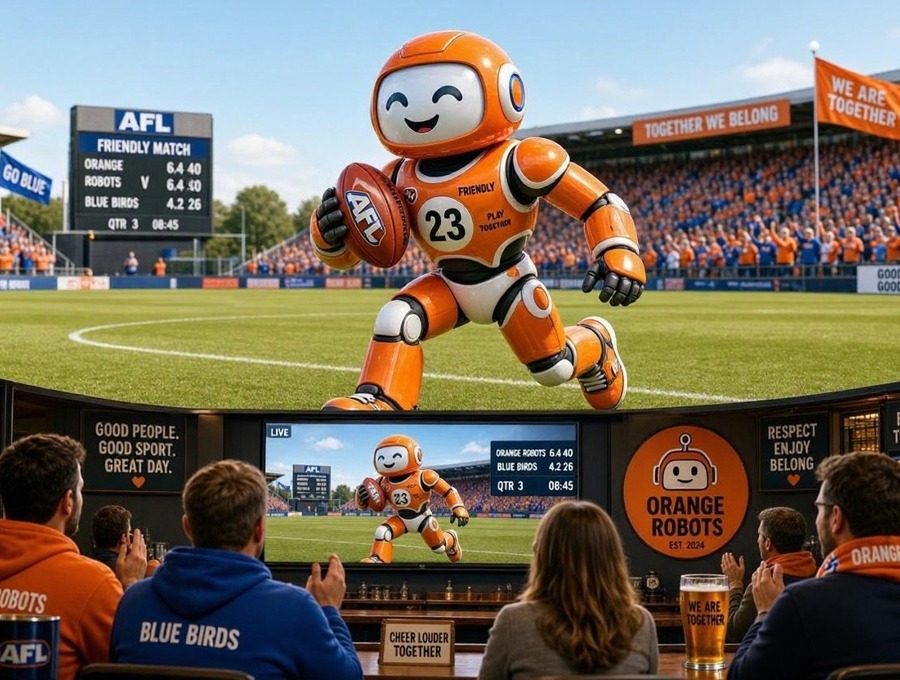
Going from AI chat to automation is a lot like going from the front bar on a Saturday arvo to Grand Final day at the MCG.
Everyone at the pub has an opinion. The coach should've thrown the ruckman forward. The umpires are blind. That kid on the wing can't kick on his left. Very few of them have laced up a pair of boots since the under-14s.
Most organisations are in the front bar on AI right now. The Copilot licences are bought, the opinions are loud, and the number of people who have actually built something is small.
Pretty much, yes.
Chat is you asking and the AI answering. Draft this email. Summarise that 40-page policy. It's genuinely useful – if each of your people saves 20 minutes a day, that's well over an hour and a half a week each, back in the bank.
But look at who's running the process. You are. You ask, you check, you copy the answer somewhere else, you do the next step. The AI has no access to the system that needs updating and no clue what happens after you close the window. The human is the process, and the AI is the commentary.
That's fine. The pub is where most people learn the finer points of the game. Nobody's been drafted from it though, whatever the bloke in the Collingwood scarf reckons.
An agent is weekend footy. Local club, amateur grade, training on Thursday nights. You're on the field now, with a team sheet and a game plan.
Three things change. The agent has instructions (its own game plan) that tell it how to behave and, critically, when to say "I don't know". It's grounded in your own documents rather than the internet's best guess. And it can take an action, not just give an answer: log the request, raise the ticket, check the register.
A staff policy helper that answers "how much personal leave have I got, and how do I apply?" from your actual enterprise agreement is an agent. So is an IT and HR request assistant in Teams that takes the request, asks the follow-up questions and logs it in the right queue.
Process handling moves from none to one step, done well. A person still passes the ball, but the agent carries it through a defined play, shared across the team.
But – like weekend footy, it's not always pretty. Agents are non-deterministic. Which means you can ask the same question twice and you may get two slightly different answers. Occasionally one will kick it out on the full. That's why the instructions matter more than the model, and why "admit when you don't know" is often the most valuable line you'll ever write in one.
Running costs are real too. If 400 staff each ask a policy agent two questions a week, that's more than 3,000 conversations a month, and agents are generally billed on consumption. Not scary, but worth estimating before go-live rather than after the first invoice!
Because pro footy is mostly boring outside of match day. Lists, sports scientists, recovery sessions, the same structured week every week. Nobody at the club turns up having forgotten their (very well sponsored) boots.
Full automation, be it UiPath RPA, Power Automate, or a Fabric pipeline runs the whole process end to end, unattended, on a schedule or a trigger. An accounts payable process churning through 3,000 invoices a month. A nightly bank reconciliation. A new project request checked against 15,000 existing records before anyone touches it. A human only steps in for the exceptions.
The trade-off is that it's deterministic. Same input, same output, every time. Perfect for paying suppliers, brittle when the input is a rambling customer email. Going pro also means the off-field work: monitoring, exception queues, and someone who gets the phone call when it falls over at 2am.
Not exactly – and this is where I'd push back on a lot of the current noise. Though full disclosure – Talos are a Microsoft Partner and an authorised UiPath partner, so we've got a dog in every one of these fights. That's also why I'm comfortable saying it: in my opinion the most common mistake right now is putting an agent on a high-volume, rule-bound process because agents are fashionable. If the steps are identical every time, an agent is a talented amateur doing a professional's job, and billing you per message for the privilege.
My rule of thumb is simple:
One person, one-off task > Chat.
Judgement over messy, unstructured input > Agent.
Same steps, every time, at volume > Automation.
The best builds mix the grades anyway. A recent project intake automation of ours was pro-level matching that handed the ambiguous cases to a human in Teams. Increasingly, that handoff can go to an agent instead. Even the best AFL side needs a few players who can read the game.
AI chat to automation isn't a ladder you climb once, leaving the bottom rungs behind. Most organisations will run all three grades at once, and the skill is knowing which grade a process belongs in.
The jump most people haven't made yet is the middle one: pulling on the boots. It's also the easiest. We run a hands-on, half-day workshop where you build two working agents in a morning – around 80 minutes of it spent actually building, with no coding and nothing to install. Public dates are on our events page, and it's a lot more satisfying than yelling at the telly from the front bar.
Cheers,
James
CEO, Talos

Use automation when the process follows the same steps every time and runs at volume, such as invoice processing or reconciliations. Automation is deterministic, so it produces the same output from the same input, which is what you want for rule-bound work. Agents suit tasks that need judgement over messy, unstructured input.
No. Tools like Copilot Chat and Copilot Studio let you build, test and share an agent without writing code. The skill that matters most is writing clear instructions, including telling the agent to admit when it doesn't know the answer.
Agents are generally billed on consumption, so cost scales with how often they're used. An agent answering two questions a week for 400 staff handles more than 3,000 conversations a month, which is worth estimating before go-live. Licensing and governance should be part of that estimate too.
Yes, and the strongest solutions usually combine them. Automation handles the predictable, high-volume steps, while an agent or a human handles the cases that need judgement. A common pattern is automation that escalates ambiguous items to a person or agent in Microsoft Teams.
Get the latest Talos Newsletter delivered directly to your inbox
TECHNOLOGY PARTNERS
Our partners including Microsoft, UiPath, Databricks & Profisee enable us to deliver business outcomes using best of breed technologies and solutions.




Automation & Analytics Technologies for Business

Australian councils face backlogs, staff turnover, and rising community expectations. We help you improve service delivery and operational efficiency through process automation — integrated with TechnologyOne, Civica, and Pathway.
Talos helps organisations build modern data and analytics platforms using Databricks, Microsoft Fabric and Power BI. We work from strategy through implementation, ensuring you get value from the platform without unnecessary complexity.
Talos helps organisations build reporting solutions using Jet Analytics


AI chat answers questions one at a time, with you running every step of the process yourself. An AI agent has its own instructions, is grounded in your organisation's documents, and can take actions such as logging a request or updating a record. It's shared with a team rather than living in one person's chat history.